This is the blog for Rhona and Bobby Hogg's VSO experience in Uganda. In August 2008 we applied to do VSO and, following an assessment day in London last October, we were accepted as volunteers . Because of the strong Scottish links, we had set our sights originally on Malawi where we spent a week in June 2008 but joint placements are difficult to find and in February we agreed with VSO to open up the search. At the end of March we were delighted to be offered placements in Kampala, Uganda. We are to work for a HIV and AIDS initiative called Reach Out Mbuya (http://www.reachoutmbuya.org/) where, we hope, Rhona's community nursing experience and Bobby's IT experience will prove useful.

We are due in Kampala on 18th September and have committed to spend a year there. We are very excited about the prospect of living in a very different part of the world and working with Ugandans who, from many reports, are fun to be with. We expect there to be many challenges but our stay in Uganda should be immensely enjoyable.

We are indebted to VSO for giving us this opportunity. Our preparation, including 2 training courses in Birmingham, has been excellent and we are confident about the in-country support that we will get from VSO in Uganda. I understand that it costs VSO around £15,000 to support each volunteer. If you would like to make a donation to support our placements in Uganda please visit the Just Giving site through the link opposite.

Saturday, 8 May 2010

The Crater Lakes

5th May 2010
We have been away for a few days to the West of Uganda. First we went to Fort Portal for a night, and had dinner with another VSOer who we met on a preparation course last May in the UK. As usual, it was great to catch up and compare notes. We had another woman from the same course, who is now in a rural part of Rwanda, staying with us in Kampala for a few days with her boyfriend just before we left. It seemed strange to think back to all the exercises we all did  together using participatory approaches and pretending we were subsistence farmers learning about micro-finance schemes!
Fort Portal is around 300 km west of Kampala and the journey should take about 4 hours. We set off at 7.30 am last Friday. We had heard that the road is good (not like the Kampala/Mbarara road) so at 10 am we were a little disappointed, after taking the usual hour to get to the other side of Kampala, to find ourselves 70 km from Kampala. 

The road from Kampala to Mityana is almost continuous road works with frequent fierce speed bumps  The road beyond Mityana improves dramatically until you think you’re back in Scotland and maybe in the Borders with rolling hills and green lush countryside. 


The journey took us 6 hours. Fort Portal is a contrast to other parts of Uganda that we know. It is a very neat and tidy town with lots of signposts and road markings, rare for Uganda. The backdrop is the grand Rwenzori mountains aka the Mountains of the Moon. Its two highest peaks are the third and fourth highest in Africa.


After our night in Fort Portal we went south to the Crater Lakes (about 45 minutes) and stayed in Ndali Lodge which is perched on a cliff top overlooking one of the lakes. The staff were excellent.


The main building has the dining room and a comfortable bar each with spectacular views on both sides. 


We stayed in one of the 8 cottages with a view of the Rwenzori mountains to the west and the distant Lake Edward to the south. 


As we have come to expect the bird life was amazing. 
Here are three Cinnamon-Chested Bee-Eaters perched in a bush not 10 feet from our cottage.


On Saturday we had a tour of the nearby vanilla farm and factory. 

We saw the pods growing in the fields and the preparation and packing in the factory.


Some appear to be dispatched to Newcastle and subsequently turn up on the shelves at Waitrose (Ndali brand). Go and have a look and tell us that you have seen them. 
On Sunday we had a good tour of the lakes with a guide. 


The drive between two of the lakes was quite exciting as we travelled over the hills on a poor track in the rain. The 4x4 was essential – never really used it before. There were some anxious moments as we descended some steep slippery slopes and other sections where I feared grounding and getting stuck. But looking back it was good fun. 


Later we did some walking on our own – well almost. 
There were four very friendly dogs at the lodge who insisted on keeping us company. 


One of the dogs slept outside our cottage every night in the base of the coffee table.
The journey back to  Kampala didn’t seem as bad as the journey out probably because the last section of road works was expected. Now we are back in the chaos and traffic jams of Kampala. 
 
At work we have two grandmothers and a  member of staff going off to a conference in Swaziland – the conference is devoted to grandmothers and their role in caring for orphans. It is a major problem as older people in Africa expect to be cared for by their children and these women not only lose their children from HIV/AIDS but become totally responsible for caring for their grandchildren, with no financial support. Reach Out helps them with school fees and sometimes with food, but have started a piggery for grannies to make their own living. They are given piglets, a sty and a month’s supply of pig food, and it seems to work very well. They are then obliged to give a set of piglets away every so often to help others get started. A lot of time has been spent helping them get their presentation together and well practiced before they fly off tomorrow. The photo is of Granny Rita practicing her part, like many older women she wears a gomezi every day as well as for special occasions. There are always jokes about not being allowed on the plane in their traditional dress, but it is just great to see them going off for a few days, the first time out of Uganda and on a plane.

Over the next few weeks we are looking forward to receiving a number of visitors from the UK ending with our son, David arriving in June. We are always pleased to hear from readers of our blog so drop us an email or leave a comment if we haven’t been in touch for some time.

Sunday, 18 April 2010

Easter vacation

We had a week (31st March to 7th April) away over Easter to Lake Bunyoni in the southwest of Uganda. It is the furthest we have been with our own car. The distance is about 420 km but the road from Kampala to Mbarara is very poor with rough road surfaces, many potholes and long stretches of roadworks. 

However the road from Mbarara to Kabale is good and interesting as it winds it way through the hilly countryside. 


Our journey was uneventful apart from a search for petrol as shortages spread accross Uganda. We left Kampala on Wednesday at 7.30 am, had a an hour stop for lunch at Mbarara and we arrived at Arcadia Cottages at 5.30 pm  when we were rewarded with a spectacular view over the island-studded lake to the more distant volcanoes on the Rwanda/Uganda border.

 Arcadia cottages is a complex of 6 cottages high on the hillside above Lake Bunyoni. In the mornings the lake was covered with mist which burned off to give a hot sunny day. Mornings and evenings were quite chilly, which meant wearing jumpers for the first time since last September, but we did not need to worry about mosquitoes.


We had a relaxing Thursday, meeting a VSO couple working in Kabale for lunch at the White Horse Inn, Kabale. It was great to catch up with news and compare notes.
 

On Friday we ventured onto the lake in a dugout canoe with a trip to Bushara Island.


Friday is market day in Rutinda the departure point for boat trips on the  lake. 


As we paddled out we passed many canoes fully laden with produce and people on their way to market.


Bushara Island is an eco-tourist centre provides accommodation, good food and trips in dug-out canoes to various places of interest. The centre provides employment to around 80 locals and the profits go to funding community projects round the lake. We returned to the mainland by motor boat!
On Saturday we drove up a back road (track) to Muka at the head of the lake and returned by the main road to Kabale. The views were marvelous and there were interesting villages and people along the road.  


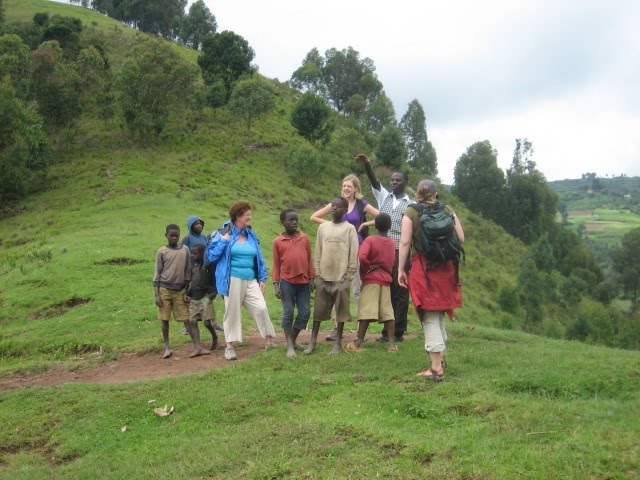
Although the scenery is wonderful, there was a slight edginess to the area and Kabale town with the children shouting “Give me money” sometimes aggressively and some adults seemed a little hostile towards us. It was a contrast to Kampala where generally people are gentle, friendly and polite.


Sunday saw us back on Bushara where we joined a walking tour of a local village.

As the  village was on the far side of the lake we traveled by dugout again. We had hoped to do some free-range walking in the hills as we do in Scotland but even with a guide we were followed by an entourage of children.


On Monday we were back at Bushara and signed up for another dugout trip - this time  to Bwama Island, the biggest on the lake. In the 1920's a Scottish doctor, Dr Sharp, set up a leper colony on the island which  remained in operation until the 1960s. 

Now the  buildings provide a school for the children from around the lake. Some travel by canoe each day; other just go home at weekends.


One of the smaller islands on the lake, Akampene Island(Punishment Island). Some time ago, the lone tree was used to  tie up and abandon unfortunate unmarried girls who became pregnant. The more fortunate were rescued by men who did not have enough cows to obtain a wife through the more acceptable process.


On Tuesday we split the journey home with an overnight stop in Mbarara at the Lake View Hotel where we had a swim in the pool in the afternoon.

In the evening we met up with a couple of young doctors who are working at the hospital. We had a brief tour of the hospital and then had dinner together and again it was great catching up. They work extremely hard in difficult working conditions and are certainly at the sharp end of providing health care in a low resource setting. They have to teach students and junior staff the way things should be done, in order to prepare for exams, while the reality of what they can offer patients is very different.
We traveled back to Kampala on Wednesday - 6 hours for about 285 km including the Kampala traffic. 
When we got back to work, I found that most of the abstracts we submitted for the international AIDS conference in Vienna in July have been accepted as poster presentations, and one senior nurse has been awarded a scholarship to attend the conference – she is quite ecstatic about her trip to Europe, as she has never been out of Africa before. It was a lot of work to prepare and submit all the applications but worthwhile, and the abstracts are all ready for future conferences.

Sunday, 28 March 2010

Transport in Uganda

Although maybe not untypical of Africa the public transport options in Uganda are quite different from the UK. In our past blogs we have referred to some of the difficulties and dangers but we hope you find the following photos interesting and amusing.
There has been no passenger trains in Uganda since 1997 so most  journeys are made by the roads which range from good stretches ( some funded by EU money) to pothole ridden obstacle courses. Uganda is a relatively small country. roughly 250 miles wide by 300 miles - the the same area as the UK (91,000 sq. miles) according to the Bradt guide.  Country-wide travel by coach/bus has its dangers. The Post Office buses are the recommended services but generally the  buses are referred to as ‘flying coffins’ and travel at night is not recommended.


In the remote areas pick-up can be the only available option but if you are not sitting inside the journey can be precarious.


The taxi service is provided by 14 seat minibuses (referred to as matatus in Kenya). Outside Kampala they are not so well regulated but within Kampala the maximum number of passengers varies little from the regulation number of 14. Although chaotic they do seem to be very effective in moving lots of people and you rarely have to wait more than 5 minutes for one. 
 A lot of taxis have religious slogans on the back windows but I don’t know if they are more successful at avoiding breakdowns and collisions.


The old taxi park in Kampala.


Outside town we believe they can be very overloaded and you may be sharing your seat with a goat. 


Inside Kampala the Boda Boda motorcycles provide a taxi service that can beat the traffic jams. In earlier blogs we have mentioned some of the many accidents we have heard about but for many it’s the most convenient way to get about. We have not had the need or the desire to use them so far. They do provide some amusing sights as there appears to be nothing that can’t be carried on a Boda Boda.


A three-piece suite.


Bags of charcoal


Chickens


An improvised windshield

Boda boda drivers take a rest.


Children come and go from nursery.


Bicycles are also a popular form of transport . They provide a taxi service and are also used to carry an amazing variety of loads.

Matooke - a staple food


Pineapples


 Kleeneeze!
 
 Bicycle repairs.


If you have no wheels you must carry your load. 


The skills in carrying a load on the head are amazing and taken to an extreme at the Ndere Traditional Dancing Centre in Kampala.


Rhona and I have not seen a baby buggy since we arrived. We expect this is because pavements are few and the pedestrian ways are generally rough tracks. 

So until they can walk babies are carried in a traditional way.


 I thank our recent visitors for permission to use some of their photos.