This is the blog for Rhona and Bobby Hogg's VSO experience in Uganda. In August 2008 we applied to do VSO and, following an assessment day in London last October, we were accepted as volunteers . Because of the strong Scottish links, we had set our sights originally on Malawi where we spent a week in June 2008 but joint placements are difficult to find and in February we agreed with VSO to open up the search. At the end of March we were delighted to be offered placements in Kampala, Uganda. We are to work for a HIV and AIDS initiative called Reach Out Mbuya (http://www.reachoutmbuya.org/) where, we hope, Rhona's community nursing experience and Bobby's IT experience will prove useful.

We are due in Kampala on 18th September and have committed to spend a year there. We are very excited about the prospect of living in a very different part of the world and working with Ugandans who, from many reports, are fun to be with. We expect there to be many challenges but our stay in Uganda should be immensely enjoyable.

We are indebted to VSO for giving us this opportunity. Our preparation, including 2 training courses in Birmingham, has been excellent and we are confident about the in-country support that we will get from VSO in Uganda. I understand that it costs VSO around £15,000 to support each volunteer. If you would like to make a donation to support our placements in Uganda please visit the Just Giving site through the link opposite.

Sunday, 5 September 2010

The Gorillas

Our final fling has been a trip to Bwindi Impenetrable Forest (the name says it all) for gorilla tracking. Many of our guests have been and so we were well prepared for the long and bumpy journey (our driver was introduced to the word shoogle, the only way to describe it). We travelled down last Sunday – just under 11 hours – and returned to Kampala on Wednesday – 12 hours. (Kampala appears to have suffered the worst tropical storm in history just hours before we returned). 
The last three and a half hours is on dirt track part of which happens to be one on the main routes into the Congo and so is quite busy with heavy lorries.

 
On Monday morning we checked in at the UWA reception. There were 3 groups of visitors with a maximum of 8 people in each. 


Each group, with a guide, two armed guards and porters for those that wish, is assigned to a gorilla family. 

We had a two and a half hour trek in - up and down precipitous tracks – to find the gorilla family we had been assigned to – the Habinyanja family. 


We spent an hour with the gorillas which made it all worthwhile. It was a really amazing experience having eye-to-eye contact with such gentle giants, by the end we felt they were our new best friends. 


I (Rhona) was very appreciative of my porter, Jonathan, who carried my rucksack and gave me a hand with the steepest parts. Bobby still claims he only hired a porter to help the local economy, he certainly did not engage in the hand-holding bit! (not true – I didn’t fancy being stretchered out)


On Tuesday, I spent a morning at Bwindi Community Hospital, an amazing place (with a good website) which provides medical care and health promotion to the people living in this very remote area of Uganda.


There are two VSO volunteers working there and it is certainly VSO - the extreme version, with very primitive living conditions, no regular transport in or out, and no access to food except the African staples. On the other hand, it is a stunning location and a great hospital with good resources. 


On Tuesday morning Bobby had a guided rain forest walk to a local waterfall. In the afternoon we relaxed with a short local walk.
 
So now it is countdown to returning home, there is much to do and a very long tick list. Today we went to the village up the hill behind our house where we often walk with visitors, and distributed printed photos of various people who had kindly allowed us and in particular our son David, to take photos of them.

We had to ask around to track them down, but we found them all and they were really delighted to have them to keep.

Tuesday, 17 August 2010

The Royal Pride Academy

Well! In 4 weeks time we expect to be home barring any airport strikes. Our attention is focused on end of placement reports and checklists for our return.
The last of our scheduled visitors departed on Thursday. We had an enjoyable time with my sister, Anne, and her husband, Wofgang who live in Germany. They were with us for 2 weeks on their first visit to Africa and experienced the chaos of Kampala traffic as well as the abundant wildlife and the friendly Ugandans.
Before we left last September a number of our friends gave us money to put to a "good cause". If you have read many of our blogs you will realise that we are aware of too many good causes in Uganda and choosing one has been difficult. However there is a primary school not far from where we stay (on the  other side of Mutungo Hill).  


The Royal Pride Academy has 200 primary school children with seven teachers for the classes P1 to P7. It is a private school (no funds come from the government) and is dependent on the fees paid by parents. Although the government has introduced universal primary education, the reality is that in most places, including Kampala, there are no state-funded schools and many children do not attend school. The school is located in a slum area of Kampala so the concept of a private school in the UK couldn't be further removed. The school has little resources apart from the dedicated head, Godfrey, and his staff who we think receive no pay.
 
You will see from the photos that the buildings are basic. 


The school is at the foot of the hill and until recently the classrooms were regularly flooded. The partner of one of the volunteers recently organised the builiding of the concrete plinths to keep the classrooms above water level and the chute and roundabout were provided by another volunteer. 
It is likely other funds will be given to improve the buildings so we are adding our contribution to this. We hope those who gave us money to use in Uganda will feel that this is a worthwhile project.


On another note, we were delighted to hear yesterday from our younger son, Hamish, that he and Morven are engaged.  With David and Kelli's wedding next spring, 2011 should be an exciting year.

Sunday, 15 August 2010

Health Visiting African Style

Rhona -
Most of my time and energy has been focused on increasing Reach Out’s research capacity and capability.
For the last few weeks of my placement I am concentrating on helping to develop better care of our babies born to HIV women. Although Reach Out seems to provide, in African terms, a Rolls Royce service to their clients, there is little monitoring of the babies in the Prevention of Mother to Child Transmission (PMTCT) programme, into which mothers are enrolled during pregnancy. 

Babies are discharged at 18 months of age if they test negative at that stage. If positive they are enrolled as clients in their own right. Babies and their mothers are given drugs to reduce the risk of transmission during pregnancy, birth and breastfeeding, which is the best option for HIV exposed babies here, given the costs and risks of infections associated with replacement feeding in an urban slum area. Almost half of children under the age of five in Uganda are malnourished, which given the fertility of the land is difficult to understand in rural areas. In Kampala, people with no jobs depend on trying to earn very small amounts of money by selling cooked food, or fruit such as mangoes and pineapples and it is common for families to have no money for food . Many families only eat once a day, which is not enough for babies, so many become malnourished between six and 18 months, when breastfeeding is not enough for them. However, there is no routine monitoring of children and some children present with moderate and severe malnutrition.

Up until now the babies have not really been clients in their own right, but now  they are being given their own file and their growth will be monitored and charted, so that faltering can be identified before they develop moderate or severe malnutrition. So before this happens, I am doing a baseline nutrition survey of all the children aged between 0 and 24 months, and then the nutritionist, the PMTCT staff and the mother-to-mother community health workers can make decisions about whether they need to increase health education or increase access to food support for some families. Fortunately there is free software available form WHO’s website which makes the survey fairly straightforward.
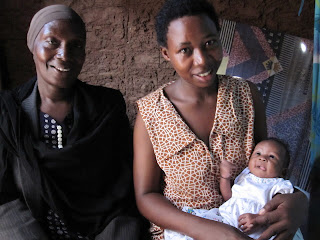
I have been out doing home visits with the clinicians and the community health workers, especially the mother-to-mother supporters (including Saban, who features in the photos) who look after women in the prevention of mother to child transmission programme. The M2Ms are all clients themselves, who have been trained to support women during pregnancy and until the child is 18 months of age.

While everyone is aware of the poverty and desperate conditions most children in the world live in, and living in Africa makes it all more real, actually coming face to face with the reality of living in a Kampala slum and even more, assessing it from a professional perspective, puts it into 3D. Most of the women have come from villages up-country but they do not want to return because they will face a lifetime of hard physical work, digging fields to grow their own food and trying to sell any surplus they have. The reality of life with no safety net is very stark.

However, while it was the differences that struck me most at first, I now see the same problems I see in health visiting practice in Edinburgh  - fathers who do not take responsibility for their children, domestic violence and some mental health problems, though post-natal depression is not recognised. I also see great similarities in the way parents really care about their children, they are very interested in seeing how their children are growing and respond very positively to being told that they are doing a really good job.

Sunday, 18 July 2010

An Adventurette?

.... or a small adventure within the year's big adventure.
We have just returned from a few days visiting fellow VSOers working in the north of Uganda, where after around 20 years of unrest the war ended in 2007.Immediately after the war ended there was a great influx of NGOs and money but now most have gone. VSO have just started placing volunteers in Gulu and Lira, the first batch of five came in February and some more have just arrived and are currently undertaking  in-country training before moving up to start their placements.

Gulu and Lira are equidistant from Kampala - around 350 kms - and the road north is very good and relatively quiet compared with the roads to the west and south west. There are long straight stretches for as far as you can see. There were a few interesting sights on the road. This lorry carrying bags of charcoal with people perched on top is not untypical.

 
Our first stop was in Lira to stay with Debs who is a public health specialist working with the District Health Office. We went out with a senior nurse to their most outlying health centre 80 km to the east over rough roads. 


About half way out we came across the lorry which was stuck in the mud. All the goods were unloaded and eventually it was pulled free by an NGOs 4WD. 

Having surveyed the scene and with confidence but little experience of 4WD I attempted to skirt round the muddiest bit. 

Unfortunately we slithered into the deep mud and were grateful to around 20 locals who manhandled us to firmer ground. (sorry no photos - Rhona wouldn't go wading in the mud!)


When we arrived at our destination we found no drugs, no food supplements for malnourished children and therefore very few patients. We then visited a second health centre on the way back and found a similar scenario. Drugs due to be delivered on 22nd June have not arrived and so the pharmacy has empty shelves.

We also had an interesting visit to a family in Lira with whom Debs stayed for two months when she arrived. The mother Anna looks after twelve children, as well as her own she has absorbed others into the household including a boy she found who had been put on the bus at Kampala who she found lost in Gulu bus station and also the two young children of her sister, who died in childbirth just three weeks ago. Anna was pregnant with her second child when her husband was killed in a car crash. 

The harshness of life in Africa, and the serenity with which people accept it and move on, never fails to affect us. Anna is luckier than many, she has a reasonable job and can afford a spacious house with a tap in the courtyard, and can afford to pay school fees for the children.
After 2 nights with Debs, we moved on to Gulu (north west of Lira - about 130 kms by the main road) and stayed with Mike and Liz. Liz is a community nurse by background and Mike has worked in mental health. They are carrying out needs assessments and working out how VSO can best progress with future placements. 

Again we traveled about 80kms east and worked our way back visiting 4 health centres in total. There was 4 in our party. Mike did the navigating and another VSOer, Judy from Kenya, wanted to gather information on health promotion at the centres. 

We appreciated travelling by car but Liz and Mike usually travel by motor bike sometimes staying the night at the more remote health centres. This is real VSO stuff - our life in Kampala seems decadent by comparison. We visited a range of health centres, which again are out of almost all drugs, including antibiotics and those used to treat malaria. We saw two very young children with a presumed diagnosis of malaria (there were no lab facilities) who were clearly very unwell and could not be given the drugs they required immediately.  
Most of the people in this area are staying in the remains of the refugee camps in numbered thatched round huts with little space between.


There are different levels of health facility, Level 1 are the village health teams, Level 2 the most basic health centre with no inpatient or midwifery service, Level 3 offering inpatient and maternity services, and then Level 4 a bit more expertise and facilities,  with the regional referral hospital catering for complex cases and general surgery etc. The Level 2 Health Centre we saw had no qualified nurses, virtually no drugs and no power. 
Nursing assistants were doing their best, some clearly very able, others less so, but were diagnosing on the basis of a few simple questions and appeared to be allowed to prescribe.


They were also carrying out deliveries, during the  night by the light of lanterns they provided themselves, and had one plastic bucket which had to be used for sterilising instruments and also for collecting the placenta. 


There is no transport in the area, so sick people and women in labour have to walk to the health centres, and the HC2s are often the only place which is accessible, and even then it is too far for some people to reach. With the HC2s so poorly resourced, it would seem sensible to concentrate on improving the HC3s and above, and the village health teams who know their own communities, and provide mobile clinics and transport to HC3s for those who need it. 


In terms of maternity care, mothers are encouraged to deliver in health centres, but it seems more sensible to build on the skills of traditional birth attendants until mothers can be cared for by qualified midwives in well-equipped (and adequately lit) centres. But this may be politically unacceptable, and mirrors the antagonism there is in the UK to closing down small hospitals and concentrating on centres of excellence. Africa’s problems sometimes seem insoluble.


Anyway, on the way  back to Kampala, we stopped at Kasaala,  a new Reach Out facility, which was started in January 2009, in the parish where Father Joseph, a founder of Reach Out, started his ministry in Africa. Unlike the Kampala Reach Out, this centre offers primary health care with some in-patient and maternity beds, to everyone in this rural community, not just people living with HIV/AIDS. 

Being rural, it also has demonstration gardens for teaching clients better ways of growing food, and like Reach Out in Kampala, has an on-site piggery for grannies to learn the skills of pig-rearing so that they can earn money to care for their orphaned grandchildren. It is a new purpose –built building and seeing the busy clinic, run by a full staff of mainly qualified nurses with a few doctors, and a well-stocked pharmacy was such a contrast to the government health centres. It does raise questions about equal access to healthcare, and Reach Out is almost totally dependent on American donors, so it is unrealistic to imagine that Reach Out’s model could be replicated across Uganda, but it seems that the government, with issues of corruption and gross inefficiencies, is unlikely ever to be able to fund an adequate health system.
Kampala is subdued and a bit tense after last Sunday’s bombings, the official week of mourning finishes today so things will maybe get back to normal. Most people, including ourselves, are avoiding the city centre and the big hotels and public places, until things seem a bit more settled.We have started to make plans for finishing our work here and our return to the UK in just over 8 weeks.

Monday, 12 July 2010

Kampala blasts - short blog

We were shocked to hear of the bomb explosions in Kampala yesterday and fortunate not to be involved. Rhona and I left Kampala yesterday morning to spend a week in the north visiting friends is Lira and Gulu and comparing health services here in the north . We are also grateful as It would appear that none of our volunteer friends were caught up in the incidents.
Thanks for you emails with your concerns.